top of page

Midwest Workforce Index
Is it getting easier or more difficult to find new employees?

SM

Release Date: January 8, 2026

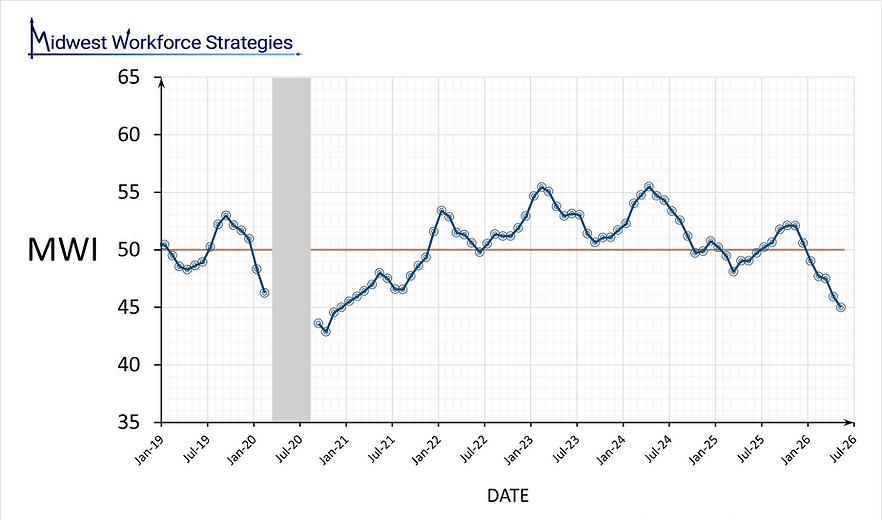
November MWI at 51.1

The preliminary November 2025 Midwest Workforce Index (MWI) stands at 51.1. The MWI creates a succinct monthly measure of changing hiring conditions in the Midwest, where values above 50 indicate that hiring was easier than in the previous month.

The Index has remained within two points of 50 for 15 consecutive months, resulting in a 15-month average of 50.2. This indicates that employment availability has remained virtually unchanged since mid-2024. Current hiring conditions now mirror conditions experienced in the two-year period preceding the 2020 recession.

Countervailing Economic Forces: The stagnation in hiring conditions results from opposing economic metrics. Reduced demand for employees (evidenced by slowly declining job openings, lower manufacturing employment, and an increase in part-time work due to economic conditions) has exerted upward pressure on the MWI.


However, these gains in hiring ease are counteracted by a reduction in available labor. This tightening is observed in lower Labor Force Participation Rates (LFPR), a reduction in layoffs, and a recent contraction of the civilian labor force.

Looking ahead, continuing economic uncertainties may increase labor availability for some sectors, but this will likely be offset by structural reductions in the labor pool, specifically dramatic declines in immigration and continued Baby Boomer retirements.

Note on Methodology: The index data is not displayed for the period immediately following the 2020 recession due to the extreme volatility of the underlying indicators during that time. Research is ongoing to better represent this period.

Regional Variance: The MWI represents the entire Midwest region. Local migration patterns, industry mix, and other demographic variations will affect specific markets; therefore, the MWI may not perfectly reflect local experiences.

Individual analyzing data on computers.

MWI Time Series (2019-2025)

MWI_November_2025.png

Note: This is preliminary work. Past values will change as the research continues.

The Basics

The Midwest Workforce Index is a research effort by Midwest Workforce Strategies. Past values of the index will change over time as the research continues and for additional reasons highlighted below. The MWI is a composite index calculated by aggregating many workforce-related economic indicators into a single dimensionless number. The design intent is to create a succinct, reasonable, and easily comprehensible measure of the change in effort required to hire new employees in the Midwest. The index design aims to show how hiring conditions may have changed in the Midwest from the previous month. It appears similar to other indicators like the Institute for Supply Management's PMI in that the range varies from 0 to 100, with a value of 50 indicating no change from the previous month. It differs in two primary ways - it is not a diffusion index, and a value above or below 50 indicates economic conditions opposite to what is suggested by the PMI. When the MWI has a value over 50, the aggregated indicators are trending in a way that suggests a possible improvement in the availability of workforce over the previous month. This would typically occur in a contracting economy. Attracting employees may be more difficult than in the prior month when MWI values fall below 50, typically occurring in an expanding economy.

The Implications

Since the index is based on various publicly released indicators, the MWI is published after the date the last aggregated indicator is released. As such, and because several indicators in the MWI are lagging indicators, the MWI should be considered a lagging indicator - the state of the workforce situation in the past. It is meant to serve as a broader confirmation of what you may have been experiencing and not as a gauge of current or future workforce conditions. More to the point, the index is meant to be used as a discussion piece as you try to understand what you see in local hiring conditions. For instance, do you work in a community that is naturally attracting or losing people? Is your industry rapidly growing or fairly level? Has your organization struggled with attracting and retaining individuals more than other organizations in your area?

Disclaimer and Terms of Use

The information provided here is part of an ongoing research project. Data is provided “as is” - solely to create a dialog about Midwest workforce shortages. The information should not be used to make business decisions. Midwest Workforce Strategies, LLC will not be liable for any damages related to your use of the data. Past MWI values will change over time as the research continues, government indicators are revised, and more recent values of the aggregated economic indicators are released. Seasonal variations in workforce conditions will likely be missed since most component indicators in the MWI are seasonally adjusted. Local conditions can vary significantly from Midwest averages, so the behavior of the MWI may not align with your regional observations. Some MWI component indicators are naturally ‘noisy’ and may generate unrealistic month-to-month variations in the MWI. Long-term MWI levels and trends are likely a better barometer of Midwest workforce conditions.

Please get in touch with me if you would like to discuss workforce implications in your community.

bottom of page